

Beadable pen supplies should be compared as a working system, not as separate colours in a craft basket. A focal bead can be attractive and still fail on the intended pen if the centre hole is too small, the stack is too tall or the finished weight makes writing uncomfortable. The pen blank, threaded rod, spacer beads, focal bead, topper and refill all have to fit and balance together.
Happy DIY silicone focal beads are sold alongside beadable pens, pen toppers, acrylic and rhinestone beads, fancy beads and other beadable items. That makes it possible to source coordinated components, but buyers should still build one approved assembly before ordering a seasonal range. Compatibility is measured on the finished pen, not inferred from product photos.
Start with the rod and centre-hole fit
The first technical question is whether every bead slides freely onto the pen’s rod without excessive play. Centre-hole dimensions can vary by material and mould, and a soft silicone bead behaves differently from a rigid acrylic or rhinestone bead. Ask for the nominal hole size and test the exact pen blank that will be used in production.
A bead that must be forced onto the rod may deform, tear or become difficult to remove. A hole that is much larger than the rod can let the bead lean and make the assembled pen look crooked. Spacer beads and washers can improve alignment, but they should be part of the approved design rather than an improvised fix during packing.
Check the threaded end as well. The cap or finial must engage enough threads after the complete bead stack is installed. If decorative elements use most of the available rod length, the top may loosen during use. Measure the usable rod, the compressed and uncompressed stack height, and the thread engagement on the finished sample.
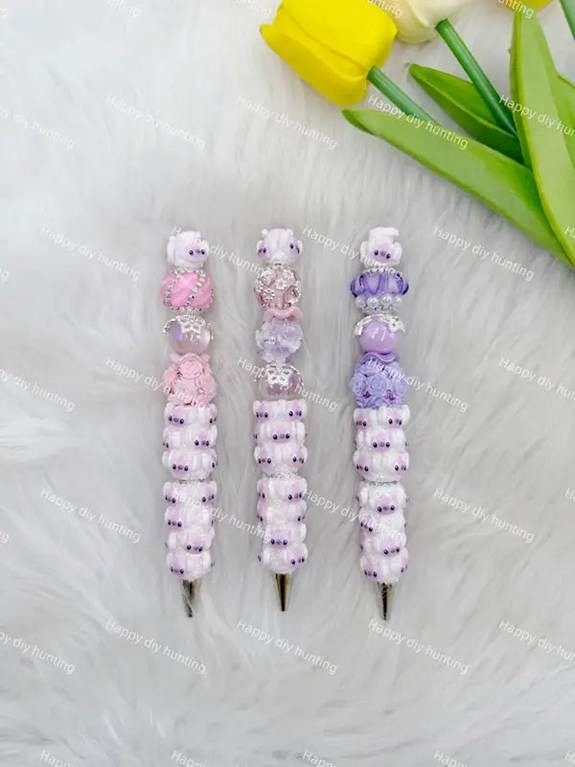
Finished samples reveal alignment, stack height and writing balance that cannot be judged from loose beads alone.
Weight and balance affect whether the pen is pleasant to use
Large focal beads, rhinestone spacers and figurine toppers can create a visually impressive pen but move the centre of gravity too far from the writing tip. The result may feel top-heavy, rotate in the hand or become tiring during longer writing. This matters especially when several dense acrylic or metal components are combined.
Build the heaviest planned combination and write with it for several minutes. Check grip comfort, rotation, cap security and whether the pen rolls dangerously when placed on a desk. Compare it with a simpler assembly. A product line can include statement designs, but customers should still receive a functional writing tool.
The visual order of the stack also influences balance. A larger silicone focal bead placed closer to the grip may feel different from the same bead at the top. Do not approve only a flat-lay arrangement; test the exact order in which the components will be assembled.
Pen mechanism quality should not be hidden by decoration
Customers interact with the refill and twist or click mechanism more often than they inspect the beads. Test whether the point extends smoothly, retracts completely and remains stable while writing. Confirm refill type, ink colour and availability of replacements. A beautiful handmade pen quickly becomes disposable if the refill cannot be identified.
Check the grip and barrel for scratches, plating defects and colour variation before assembly. After adding beads, operate the mechanism repeatedly and make sure the decorative stack does not loosen. If pens are sold as kits, include clear instructions for opening the rod and replacing the refill without scattering parts.
Silicone, acrylic and rhinestone components need different checks
Silicone focal beads should be inspected for clean moulding, consistent colour, surface marks and a well-formed centre hole. Because silicone is flexible, measure the bead without squeezing it and compare colour under consistent lighting. Strong odour, oily residue or embedded contamination should be investigated before the material is used in products.
Acrylic beads require attention to cracks, chips, bubbles, print position and sharp edges around the hole. Rhinestone components add checks for stone placement, adhesive residue and snagging. Run a soft cloth over the assembled pen to reveal projections that could catch on a pouch or clothing.
Mini figurine pen toppers and cartoon elements should be checked for paint consistency, secure attachment and scale relative to the pen. Decorative craft components are not automatically children’s toys. Sellers should use accurate age and safety information and keep small parts away from young children.
Colour variety is useful only when batches remain coordinated
A broad palette helps makers build themes, but naming a colour “pink” or “lavender” is not enough for a repeat collection. Photograph approved combinations under neutral light and retain physical references. When restocking, compare new beads with the existing pen blanks, spacers and packaging.
Colour can differ between materials even when the names match. A silicone pastel may look warmer than an acrylic bead or painted topper. Decide whether the collection needs a close match or an intentional contrast. Mixed-material sets should be approved together.
For branded retail products, use a simple bill of materials with the exact link, colour, quantity and position of every component. This prevents a maker from replacing one similar-looking bead and changing the finished design without noticing.
Seasonal buying should begin with reusable components
Happy DIY Hunting carries themed collections and a large assortment of focal beads and pen toppers. Seasonal designs can sell quickly, but buying too many highly specific characters creates leftover inventory after the event. A safer assortment combines reusable base pens and neutral spacers with a smaller quantity of seasonal focal pieces.
Plan the collection as interchangeable modules. The same pen colour and spacer set may support Valentine’s, spring, sports or Halloween focal beads. This reduces the number of slow-moving components and makes it easier to create new combinations from remaining stock.
Before committing to a theme, assemble several price points: a simple silicone-bead pen, a focal-bead design and a detailed topper or rhinestone version. Record component cost and assembly time separately. The most elaborate pen is not always the most profitable.
Bulk buyers need a sampling and inspection routine
Start with small quantities of the pen blank, focal bead, spacers and topper. Approve the complete assembly and keep it as the master. For bulk receipts, sample cartons across the shipment rather than inspecting only the top bag.
Count components, verify colours and check a defined number for hole fit, surface defects and size. Assemble several pens from each sampled batch and test the writing mechanism. Record defects by type so future purchases can focus on the actual source of rework.
The store states a processing time of one to three business days and advertises free shipping on qualifying U.S. orders, with estimated delivery language on its homepage. Businesses should add transit, customs where relevant, receiving inspection and assembly time when planning a launch. A dispatch estimate is not the date finished pens become saleable.
Packaging should protect the design without bending it
Top-heavy pens and three-dimensional toppers can be damaged in a flat mailer. Use a sleeve, pouch or box that prevents the pen from moving and keeps pressure off the decorative stack. Test the package by dropping and opening it, then operate the pen and inspect the threads.
Include the refill type, care guidance and small-parts notice where applicable. If customers can rearrange the beads, explain how to tighten the top securely. Packaging is also a good place to distinguish a handmade decorative pen from a toy.
The beadable pen supplies collection includes blanks, complete themed pens, mechanical pencils, touch-screen pens and rod extenders. Buyers should confirm whether they are purchasing a blank, a finished product or an accessory and then select compatible focal beads and toppers.
The most useful comparison is a finished writing test
Colour variety can attract attention, but repeat customers notice whether the pen is straight, secure and comfortable. A five-minute assembly and writing test reveals more than a long image gallery: hole fit, available thread, weight balance, mechanism quality and surface finish all become visible.
Buyers who approve complete combinations, retain material references and inspect incoming batches can use a wide bead assortment without sacrificing function. The strongest beadable pen is not the one with the most decorations; it is the one whose decorations still allow it to work well as a pen.